
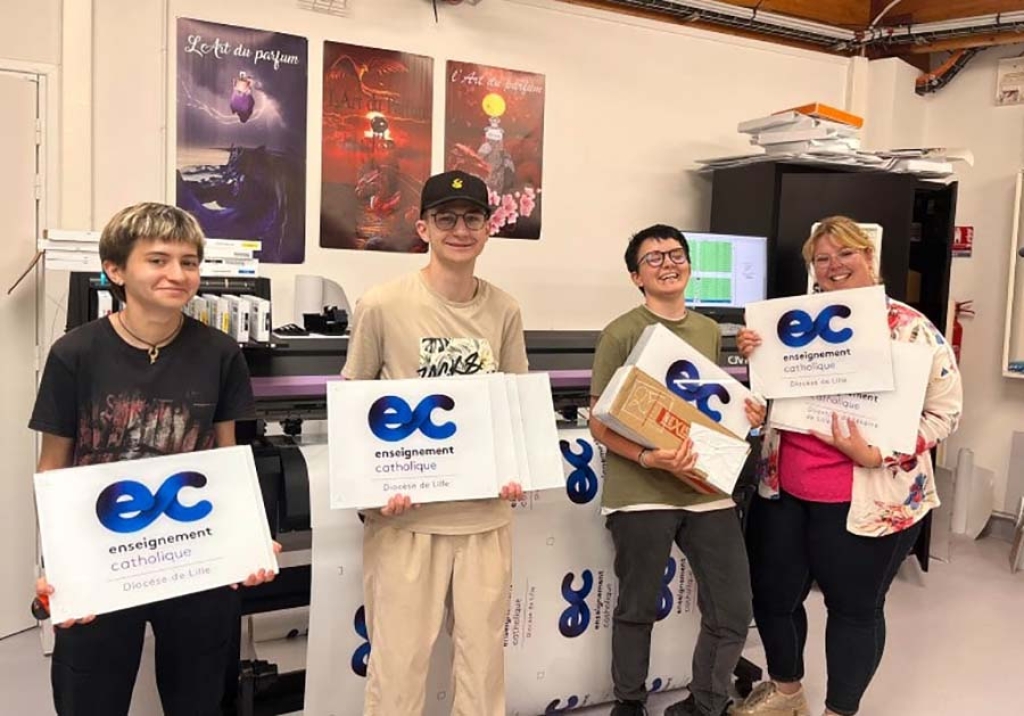
But before going back in the history of the city of Bailleul, it is important to celebrate a recent success: the graphic design section of the Salesian house in Bailleul has been chosen to create the plaques that will be placed at the entrance of every Catholic school in the diocese of Lille. For the occasion three students, Aaron, Arthur and Cassandre, students of the BMA2, together with their teacher, Mrs Balza, were received by Olivier Deltour, Diocesan Director of Lille, and all the school principals gathered in assembly offered them their best wishes and congratulations.
Returning to the history of Bailleul, we must go back to 1841. The Dames de Saint-Maur (sisters of the Enfant Jésus-Nicolas Barré) founded a nursery and primary school in Bailleul. It was they, more than a century later, who in the 1964-1965 school year, opened a technical course within the Sainte-Marie Institute, which already included a primary school, a middle school and a general secondary school for girls.
At the end of the 1960s, the three ‘protagonists’ of Catholic education in Bailleul (the Salesians of Don Bosco at the Immaculée-Conception college, the Sisters of Saint-Maur at Sainte-Marie and the Gabrielites at the Saint-Albert college) reflected on the creation of a unified school network. The foundation stone was laid in 1969 with the merger of the girls college‘ (Sainte-Marie) and the boys college run by the Salesians. Fr Léon Cotten, a Salesian (who died in 2021), became Director of the two campuses of the institute.
In 1972, the Don Bosco network took over the running of the three former secondary schools in the city. The religious men and women of the three congregations worked together under the direction of Fr Casimir Le Bras, a Salesian. In the same year, a class was also started with 50 students divided into two sections.
In 1976, Fr Le Bras handed over to Fr Bernard Bloyet, who became Director of the college and the adjoining Sainte Marie institute. In accordance with the ‘Habby’ law, he prepared the split: at the beginning of the 1979 school year, the college became the Immaculée Conception private college, while the Sainte-Marie technical school became a vocational high school (LEP, in French). Soon, the number of students rose to around 150.
1985 marked a turning point: after nine years at the helm of the institute, Fr Bloyet left Bailleul. Dominique De Lat took over as head of the college, while Régis Vandenbogaerde took over as head of the LEP. The college and the secondary school were now separate. The secondary school had just over 150 students, which would grow to 550 just ten years later. A BEP (Brevet de l'Etudes Professionnelles) in Civil Design was created, complementary formation courses were launched and, in 1986, a training centre for unemployed adults was created.
Two years later, the first professional diplomas were established, then in 1990 a graphic arts course was opened and in 1992 a hotel section. The school had 700 students in 2006 and a floral art course was opened in 2010. The boarding school, which opened in 1974, also continued to grow.
M. Vandenbogaerde was succeeded as director by Benoît Bulteau for the LEP and Patrice Joye for the Don Bosco centre. Franck Doublet then replaced Bulteau in 2012, before passing the baton to Isabelle Marcant, headmistress of the Sainte-Marie secondary school, in co-direction with Joye, still director of the Don Bosco centre.
The last major change dates back to 2020, when the Sainte-Marie vocational secondary school and the Don Bosco Centre became the Sainte-Marie – Don Bosco home.
‘For 60 years, everyone who has given life to our high school, whatever their role, has been committed to looking towards the future with hope and confidence for every young person,’ commented Headteacher Marant during the 60th anniversary celebrations. ‘This is the strength of our House.’
