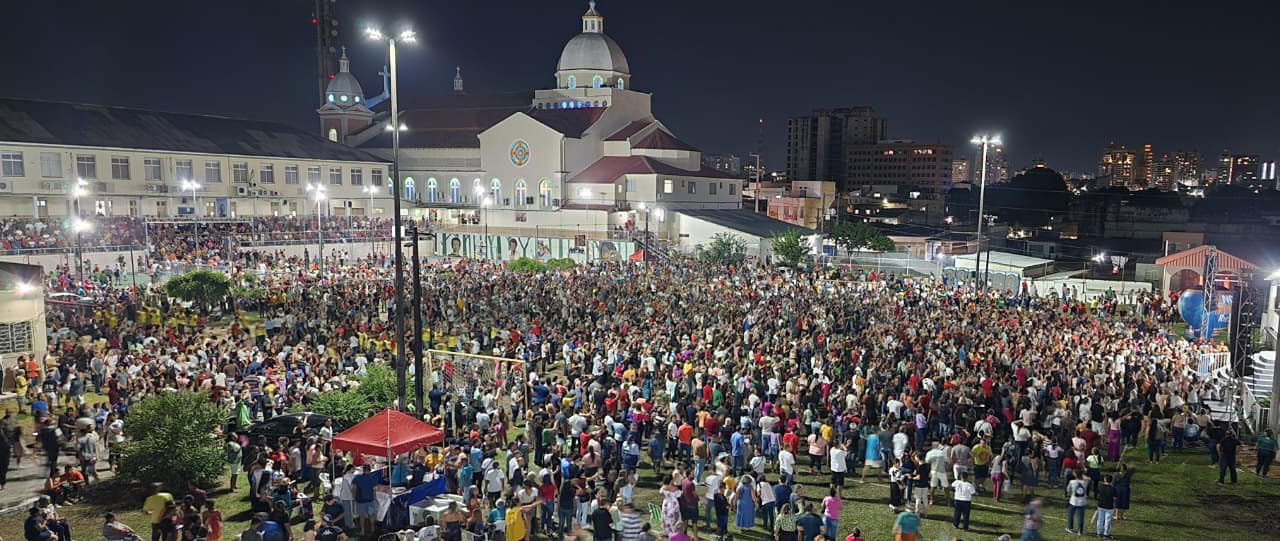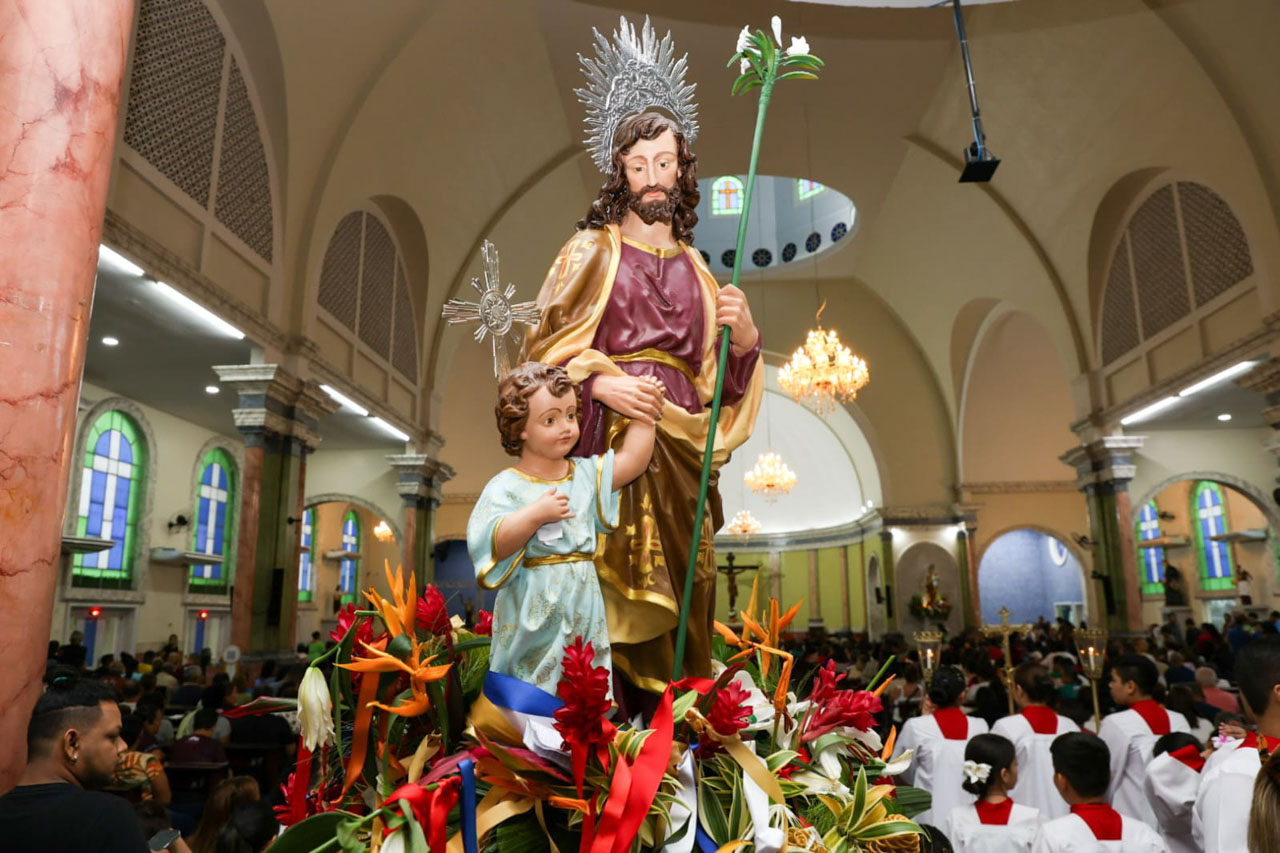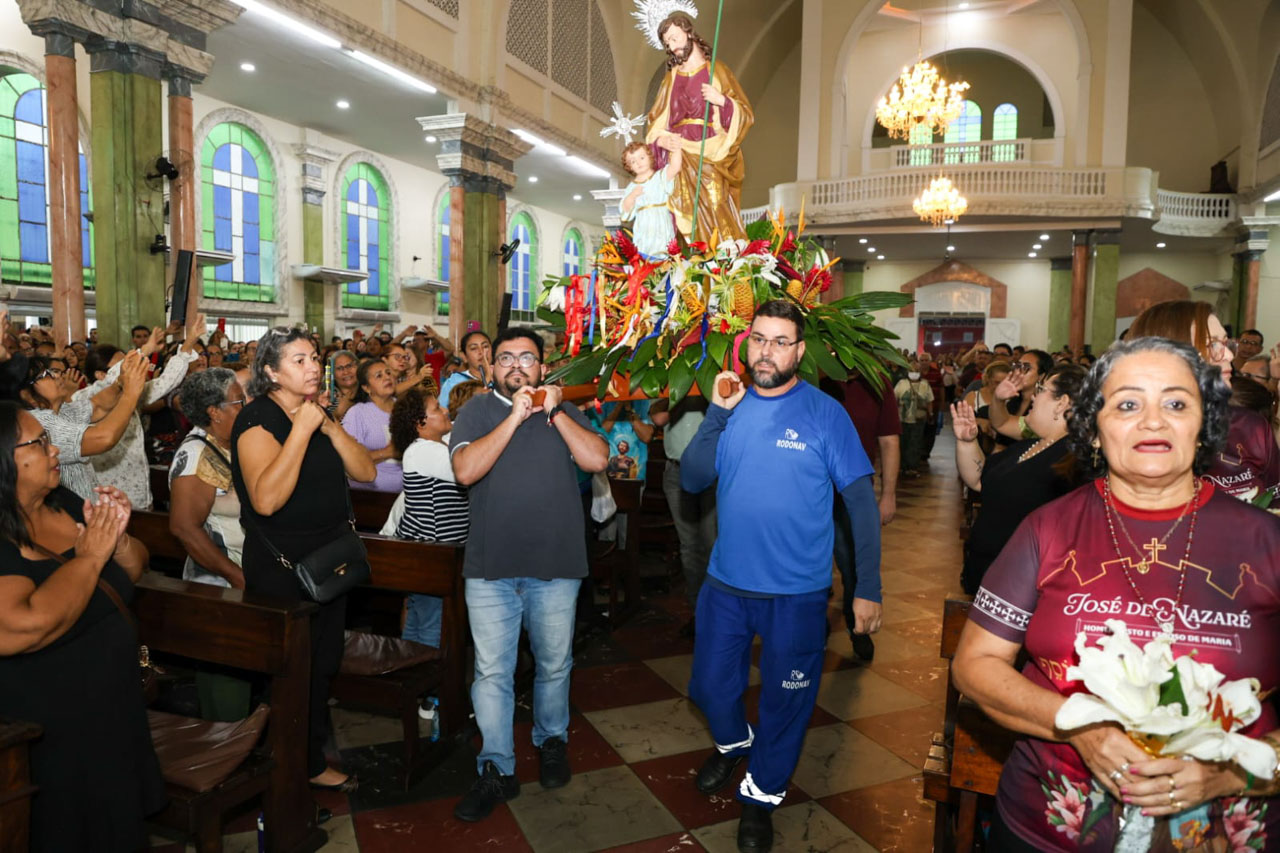
At the Archdiocesan Shrine of St Joseph the Worker, entrusted to the Salesians of Don Bosco, devotees, pilgrims and visitors to St Joseph encounter Jesus through the powerful intercession of the Carpenter of Nazareth.
According to the parish priest and rector of the Shrine, Father Francisco Alves de Lima, SDB, the people of the Amazon regard Saint Joseph as a “Spiritual Father”, present in the daily lives and faith of the people of the North. “Devotion to Saint Joseph has deep roots here in the Amazon, given that there are countless communities and chapels dedicated to him. The simplicity of Joseph of Nazareth resonates deeply with the lives of the people of the Amazon, who identify with his way of being, characterised by hard work, simplicity and the daily struggle. Proof of this is the Novena of the Blessing of St Joseph, which has been celebrated on the 19th of every month for over 25 years. It has become an effective tool for evangelisation, as well as an experience of profound popular piety that helps us to understand and imitate the virtues of St Joseph.”
Novena of the Blessing of St Joseph
The Novena of St Joseph was established in 1999 in preparation for the Jubilee marking the 2,000th anniversary of the birth of Jesus Christ, a time when St John Paul II called upon the Church to innovate in matters of evangelisation and the spiritual care of the people of God. In this spirit, the parish priest at the time, Father Sérgio Lúcio Alho da Costa, SDB, conceived the novena.
Over the years, the novena has grown in popularity as an expression of popular devotion and has been adopted by other Salesian parish priests. In 2021, it was declared by the State Legislative Assembly as Intangible Cultural Heritage of Amazonas.
Joyce Marinho, coordinator of the Parish Pastoral Council (PPC), explains that there is an important element that needs to be highlighted: the joint work of the pastoral workers at the Shrine during the monthly celebration of the novena, facilitating the devotees’ encounter with God through the hands of Saint Joseph: “To ensure the smooth running of the novena held every 19th, monthly meetings are held for planning, coordination and evaluation. At these meetings, all aspects related to the novena are discussed and defined, including reception, security, liturgical preparation, leading the liturgical singing, the role of the leaders responsible for guiding the faithful, communication and information for the public, and meals for the ministers serving, amongst others. “This joint organisation enables integrated and efficient coordination, ensuring that the novena takes place in a harmonious, participatory and well-structured manner,” he shares.
It has been over 25 years since this act of faith and devotion began, bringing together numerous devotees from all parts of the Manaus metropolitan area and neighbouring municipalities. Currently, the Novena of the Blessing of St Joseph takes place at five times: 6am, 9am, 12pm, 4pm and 7pm, with the first and last novenas held outside the Sanctuary.
Among the active and committed pastoral workers is Nazareno de Jesus, deputy coordinator of the St Joseph Novena organising team. He has been serving and helping since the very first novena held at the Shrine. “I am very devoted to St Joseph, who is a worker and the patron of the family. So, I feel obliged to help. St Joseph inspires me more and more to be a better family man and a dedicated worker,” he emphasises.
Miracles
The “House of St Joseph” is also a place of miracles. The devout Wânia Braga, a civil servant, shares the miracle her family received. Her brother had to undergo delicate surgery on his head due to cerebral oedema. At the end of the procedure, the family received the devastating news that he had been declared brain dead.
“Our world seemed to collapse. Faced with pain and fear, we asked everyone for their prayers and, with unshakeable faith, I implored Saint Joseph to intercede for my brother’s life and health. I placed that impossible situation in the hands of the one who is a father, protector of families and a model of absolute trust in God’s will. And, late in the afternoon of that very same day, we received news from the hospital that filled our hearts with hope: my brother had opened his eyes and was well,” recalls Wânia Braga, emotionally. And, if we were to speak to other devotees, we would find many signs of the loving protection of the one considered the saint of ‘discreet miracles’, the glorious Saint Joseph.
Patron Saint’s Day
Every 19th is a busy day at the Shrine of St Joseph. But on 19 March, the Solemnity of St Joseph, the devotees experience this day in a special way. There are various expressions of gratitude to the “Saint of Lent”.
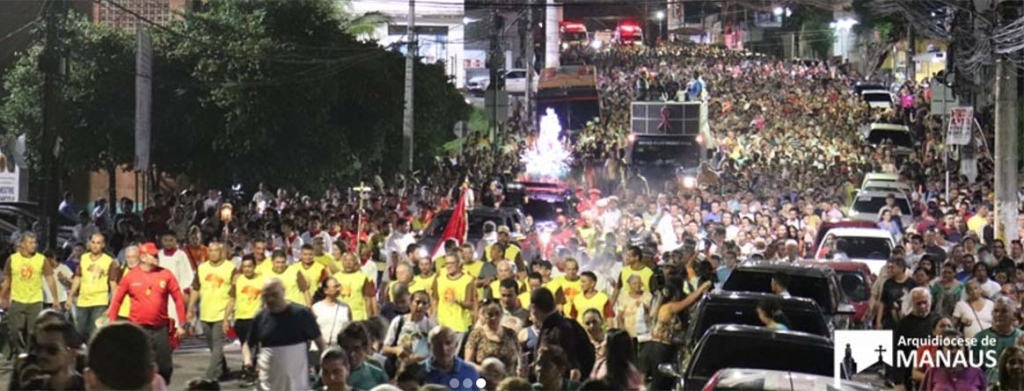
In 2026, under the theme “Joseph of Nazareth, Strong Tree, Protector of Mary and Jesus”, devotees take part in the traditional novenas and procession, winding through the streets of the Praça 14 de Janeiro, Centro and Cachoeirinha neighbourhoods, located in the southern part of the Amazonian capital. Around 80,000 devotees are expected to visit the Sanctuary throughout the day.
The theme evokes the figure of Saint Joseph as a strong tree, blessed by God, not to bear fruit, but to provide a protective shade for Jesus and Mary. In the Amazon, there are various leafy trees, such as the samaúma, mango, angelim and chestnut trees. Just as these beautiful trees are unique and special, Joseph is the tree rooted, blessed and strengthened by God. Another perspective is the term ‘family tree’, given that Joseph links Jesus directly to the lineage of David. Let us also remember that we are “branches connected to the true vine, which is Jesus” (cf. Jn 15:1-17). If Joseph is the father of the Trunk, we can also say that he is the “spiritual father of the branches”.
Manaus, City of Saint Joseph
For Manaus, 19 March is even more significant, because Saint Joseph has a very strong connection with the city’s own history. In the region where the original nucleus of the present-day city is located, the Fortress of São José da Barra do Rio Negro was founded during the colonial period. In other words, the city’s foundation was entrusted to the protection of Saint Joseph.
Furthermore, there are other expressions of devotion to Saint Joseph, such as the old São José Cemetery, dating from 1856; the Archdiocesan Seminary of St Joseph, which trains future priests for the Archdiocese of Manaus and other dioceses in the Amazon; and the neighbourhood of São José, one of the city’s most populous areas; as well as the Shrine of St Joseph the Worker, which was elevated to this status around ten years ago.
It is worth noting, too, that the Salesian Family, from its very origins, has held a deep affection for Saint Joseph, the saint of Providence, one of the patron saints of the Congregation of the Salesians of Don Bosco.
Source: Salesian Bulletin of Brazil
https://www.infoans.org/en/component/k2/item/27422#sigProId0c5d9dfa50