
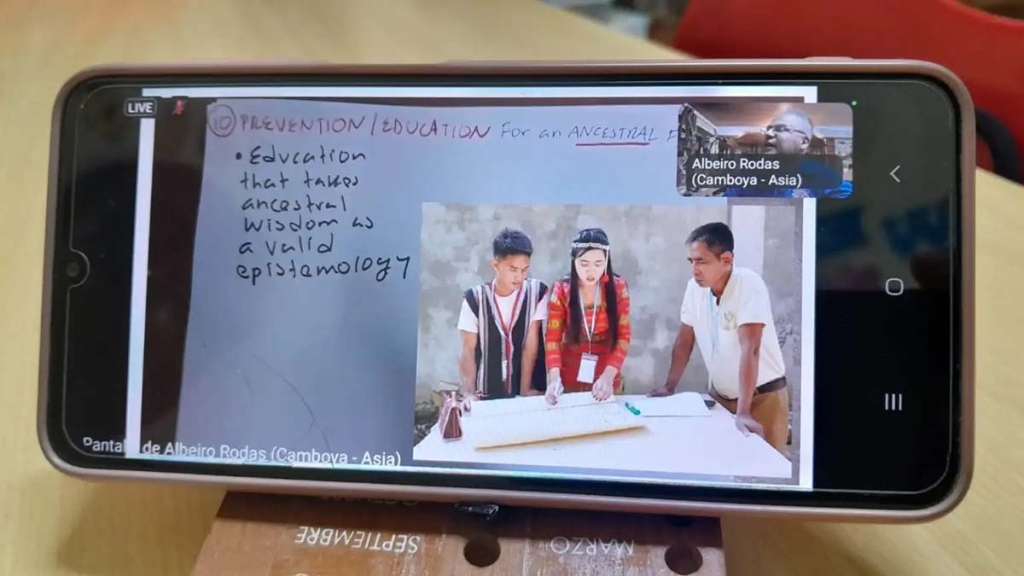
The first online Congress on Creation Spiritualities in Dialogue, held on 29–30 October 2026, brought together theologians, scholars, and pastoral workers from South America, Africa, and Europe. Organized by four theological institutions in Bolivia, Rwanda, and Germany, the event explored integral ecology, highlighting the close relationship between care for creation, social justice, and the spiritual traditions of different peoples.
Fr. Albeiro Rodas, a Salesian missionary based in Cambodia, participated as a lecturer, presenting his research entitled “From Memory to Prevention: Pastoral, Educational, and Community Praxis for Integral Ecology in Latin America.” Currently completing a Master's degree in Missiology through the Saint Paul Theological Faculty of Cochabamba, Fr. Rodas brought together his academic work, Salesian educational experience, and his own Indigenous Colombian roots.
His presentation explored how ancestral memory, cultural identity, and Indigenous wisdom can inspire new approaches to environmental responsibility and education. Drawing on the Salesian Preventive System, he proposed an “Ancestral Future” in which the education of children and young people is rooted in ancestral knowledge, respect for cultural identity, and a renewed relationship with creation.
“We are inspired by the wisdom of our ancestors, including biblical ancestors such as Abraham, who left his own land amid uncertainty, guided by a profound trust in that mysterious voice,” he reflected.
The congress also included an important Asian contribution through Fr. Michael Bistis, professor at the Faculty of Humanities of Saengtham College in Bangkok and researcher on Indigenous cultures in Chiang Mai Province, Thailand. Both participants are connected with ROOTS Asia, a network promoting theological reflection and pastoral approaches from Indigenous perspectives.
Other presentations explored the spiritual traditions of Indigenous peoples in the Amazon and across Abya Yala, the relationship between the forest and community life, and the importance of recognizing Indigenous spirituality as a source of wisdom for Christian ecological ethics. Speakers emphasized that human beings are called not to dominate creation, but to live in relationship with it as its guardians.
For the Salesian mission in Cambodia, where young people from different ethnic communities are part of the educational community, these reflections offer meaningful opportunities for dialogue between education, faith, and cultural identity. Fr. Rodas's participation also highlights the value of bringing Indigenous perspectives from Latin America into conversation with the experiences of Indigenous peoples in Southeast Asia.
The congress concluded with a message of hope: ancestral wisdom, theological reflection, and education can work together to inspire a more caring and sustainable future. It also reaffirmed the importance of listening to Indigenous peoples, not only as guardians of cultural heritage, but as active contributors to the future of the Church and our Common Home.
