
“Don Bosco was deeply committed and was simultaneously pursuing the foundation of the Institute of the Daughters of Mary Help of Christians, the vision of the Salesian Cooperators, the creation of the Salesian Bulletin, and preparing the departure of missionaries for Argentina and Nice, in France. Everyone told Don Bosco that he needed to strengthen what already existed, but that was not the challenge for him. That is to say, there is a missionary dimension that is not something pragmatic or efficient, but a way of thinking, of contemplating reality beyond the physical or metaphorical boundaries of the Salesian presence.”
The Salesian Constitutions invite us to be “signs and bearers of God’s love towards young people”: what does this mean today?
It is a question that remains highly relevant. Because we are not talking about an ideological or philosophical message, but about a call. A call from Jesus Christ, who proposes, who invites.
When we look at the example of Don Bosco, we see not so much what he did, but what he was. In recent years, there has been an emphasis on understanding Don Bosco as a person who discovered God’s plan. Our cultural context is not the same as his, but does this perhaps mean that the message no longer makes sense?
We must grasp the profound dimension of the charism, which is the ability to reach out to the person. The challenge today is not so much what we want or what we must do, but rather to rediscover our identity. And everything we find in the Constitutions has its roots in the Gospel.
The Argentina we know today is not the same as yesterday’s, and tomorrow’s will undoubtedly be different from today’s. In this sense, we have the opportunity to understand, reflect upon and contemplate what the Salesian charism is.
At this particular moment, we Salesians are in 137 countries, in very diverse contexts. But in all these places ‘something happens’ when there are Salesians who have a clear sense of their own purpose and a deep understanding of the charism. And that ‘something’ has to do with the sought-after and desired encounter between educators, Salesians, lay people and all members of the Salesian Family. So the first challenge today is not to forget that we have the talent, which is the Salesian charism, the Preventive System.
It is therefore clear that the call to be signs and bearers of God’s love remains valid. The need that exists is very evident. And if a person truly has the heart of an educator – which means being willing to listen, to accompany without judging, to welcome without imposing conditions – the young people are there.
What contribution does this time make to the charism, and what contribution can the charism make to this historical moment?
We can speak of the charism as ‘a thing’, but personally I prefer to listen to and speak of people. It is therefore appropriate to consider the question from a personal perspective: the Salesian charism is an experience. To the extent that we seek to understand it, we will see how Don Bosco lived it in his day and how we must interpret it today.
In the Preventive System, when we speak of reason, we are not referring to something philosophical, nor to something ideological, but to something very practical. The first thing Don Bosco proposed in his day was to reach out to the person. In an individualistic and highly fragmented culture, Don Bosco invites us to look to the person. The person is not a number; the person seeks to be recognised, and is also seeking to get to know you.
It is important to recognise that young people are searching for meaning. We live in a context where religious practice is on the decline, yet the search for spirituality and meaning is growing. This is an aspect we must explore further, because in the West – and consequently in Argentina too – phenomena are occurring that invite us to strengthen hope, not despair.
On the other hand, we have a problem with the translation of the word “amorevolezza”. It does not simply mean “love”, but involves two acts: the dimension of desire, “I want”, and the will, the choice to love. That is to say, it is a love full of will.
Why is this important? In today’s culture, we offer schools, oratories, parishes, centres and social initiatives, where people feel at home. So today, this context is a very favourable climate because it is a climate that needs the human dimension, where young people are seeking meaning. For example, is the family today a home, or is it more of a place? Are the deepest, most meaningful relationships found in most families, or are young people seeking them elsewhere?
We are living in a very interesting time, full of opportunities. As soon as we launch an experience that humanises young people, they respond immediately. We must rediscover the dynamic, the experience of Don Bosco, not as something archaeological, but as something alive, which offers and transmits life.
Online gambling, medicalisation, mental health… Are these problems that affect only young Argentinians, or is it a global situation?
Based on my experience over recent years, during which I have visited many countries and listened to young people, the questions I heard in Vietnam are the same as those I heard in Madrid; those I heard in France are the same as those I heard in Ecuador. The question we ask ourselves is: why do these challenges exist? Where do they come from? Pope Francis spoke of a globalised indifference.
The number of young people seeking help for their mental health is rising at an alarming rate, and not just in the West, but all over the world. There is a cultural model, a social model that is becoming increasingly prevalent: demographic change, there are far more small families, there is much greater fragmentation in human relationships, anonymity, individualism… It is important to raise awareness of these issues because we have parents and adults who do not realise how the digital world is influencing their children.
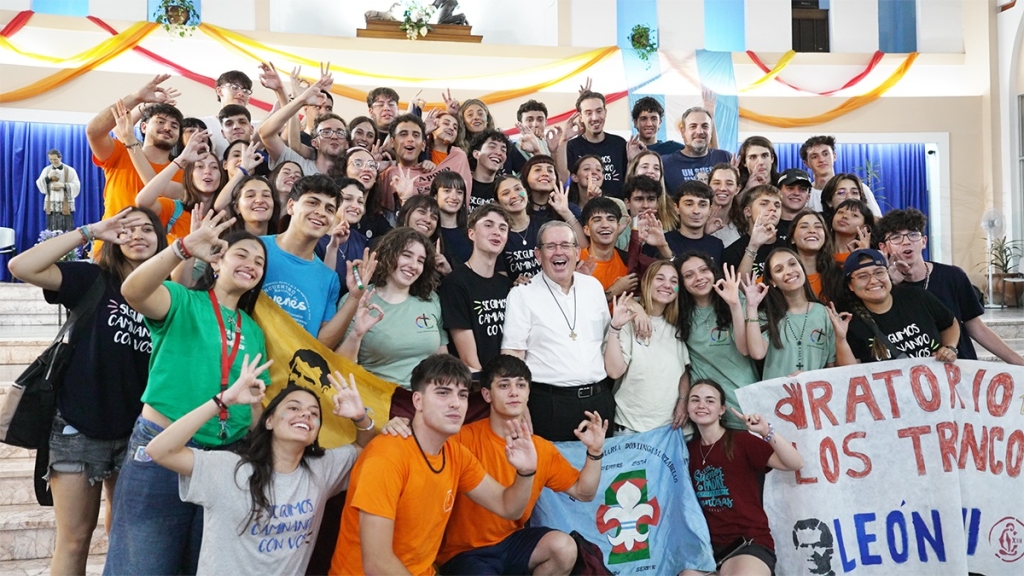
In our communities, young people feel welcomed and listened to; they feel that there are adults who treat them as people. I do not know if we have all the answers, but we certainly have a proposal, and that is what Don Bosco left us as a legacy.
We have a great responsibility, the challenge of supporting educators so that the educational community continues to be a human space, one that strengthens the search for meaning, and with the conviction that when we find ourselves in difficulty, it is not a lack of hope that should fill my life, but the possibility of finding meaning, the hope that different people help me to grow in my life, in my heart.
Source: BS Argentina
