
‘AI in the classroom is a reality that we cannot ignore, but its use carries many risks if students do not know how to use it,’ explains Bernadàs. For the EUSS professor, AI can serve to ‘accelerate content production’ as long as ‘you are an expert in the specific field.’ This is precisely the problem for students: they do not have enough experience to detect errors, inconsistencies or paradoxes in tools such as ChatGPT.
For this reason, the EUSS is convinced that it is necessary to ‘facilitate reflection and critical thinking in response to AI answers so that future engineers can develop professionally and successfully’.
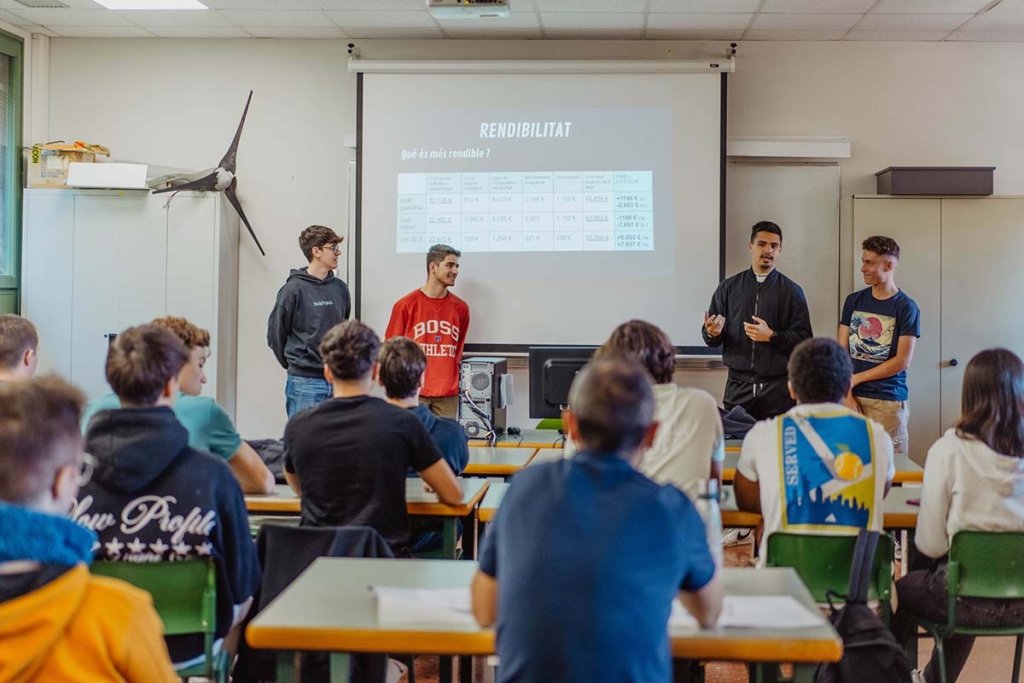
This idea is the result of the pilot test carried out this academic year as part of the Technical Office and Project Management course. The teaching staff detected the use of AI in students' work and assignments, which reflected ‘blind trust in AI responses’.
Based on this result, the course team decided that it was necessary to regulate the use of these tools, but above all to train students in how to use them. The first action was to organise a session to explain how machine learning models work: the introduction of data for training, the role of creativity in the results provided, and their limitations. The second measure was to apply the criteria of the American Psychological Association (APA) in the mandatory citation of content assisted or generated by AI tools.
AI prohibited, limited, permitted or mandatory
The pilot test of the course has aroused the interest of the entire teaching staff at the University. In this regard, the management team has decided to launch a participatory process to regulate the use of AI in the classroom and train the centre's staff to gain in-depth knowledge of these tools.
Throughout this semester, the teaching staff has begun discussing the role that AI should play in their subjects. Subjects have been labelled according to the degree of presence of these tools: prohibited, limited, permitted or mandatory.
For the head of studies at EUSS, Victor Martinez, this work has made it possible to ‘open a debate that was inevitable’ and to start working towards ‘common criteria’. ‘What we have done is anticipate a structural change in higher education,’ he adds.
In parallel with all this work, the university is also collaborating with other Salesian Institutions of Higher Education (IUS) in Europe on a research project on how AI is transforming the educational experience in different centres.
‘Artificial intelligence is a paradigm shift that directly affects the relationship between teacher and student,’ says Andreu Moreno, head of Pastoral Care at the EUSS. ‘Doing it together is a strategic decision: the richness of this research lies precisely in its diversity,’ he concludes.
About the EUSS
With an educational tradition dating back to the late 19th century, the Salesian University School in Sarrià, Barcelona, is an institution of higher education whose mission is the training and comprehensive development of future engineers and industrial managers, with a special emphasis on the practical side of studies and job placement, while promoting active participation and spirit.
The EUSS has launched the Engineering by doing programme, an educational initiative structured around the development of students' professional skills. This programme is the result of a project based on a consultation with the socio-economic environment (business leaders, university representatives and social agents).
Source: Salesianos.info -
