
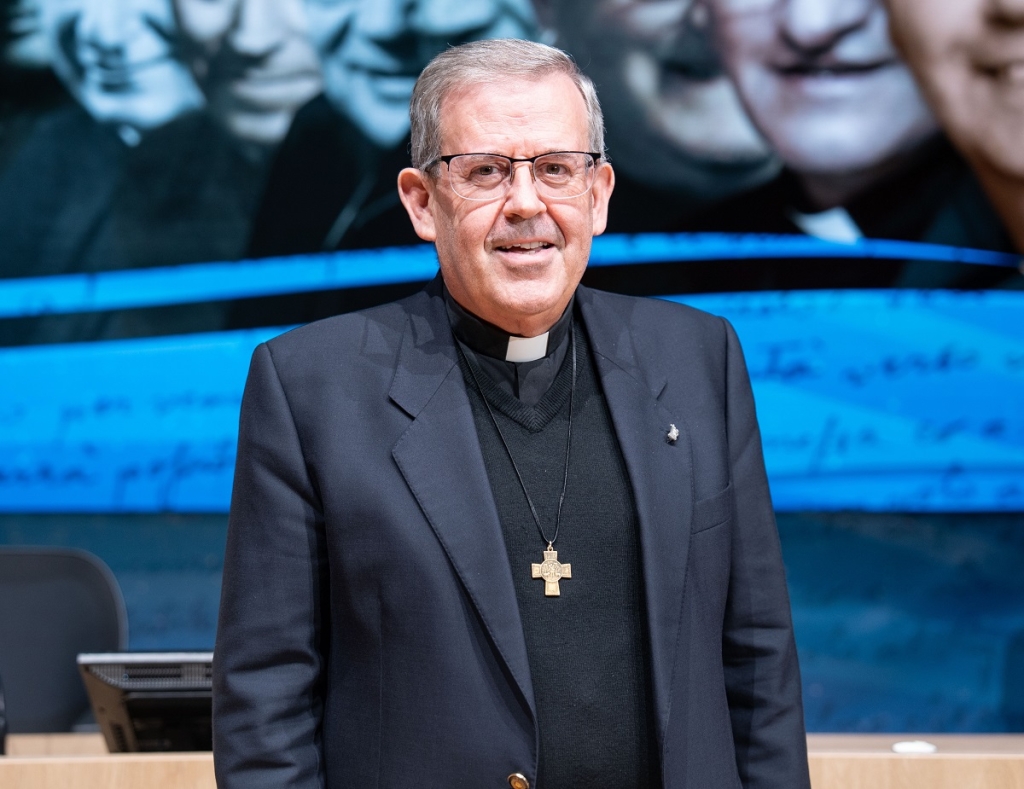
1. Fr. Fabio, one year has passed since your election as Rector Major. How would you describe this first year of your mandate?
I would describe it as a year of discovery — discovering a reality that is diverse and complex at the same time. And yet, one thing I constantly confirm within myself, having served on the Council before, is the silver thread of the Salesian charism.
I continue to see how Don Bosco is truly alive and present in the diverse contexts of the Congregation. In every context, there is meaningfulness in the way the Salesians are living their charism. For me, this year has been a confirmation, on a much larger scale, of what I had already known before I was elected Rector Major.
2. There have been many memorable moments and events for you this year. What have been the most memorable moments?
Two memorable moments surface very clearly in my mind and heart.
The first is the celebration of the 150th anniversary of the First Missionary Expedition. Through those commemorative celebrations, I had the opportunity to deepen my understanding of what happened at that time, and then to relive those experiences both in Turin and in Genoa. There, I rediscovered the greatness of Don Bosco — a firm believer who dared to look at the globe with a missionary vision.
The second moment was our visit as the General Council to Pope Leo XIV. We had the opportunity to meet the Holy Father together. In a way, we imagined ourselves as Don Bosco and his councillors meeting the Pope. It truly felt like a father meeting his sons and blessing us. Those were two very powerful and meaningful moments for me.
3. Have you felt that some of your dreams are already beginning to take shape? Are you content?
I would say it does not depend so much on dreams. It depends more on the priorities that the General Chapter has given us. My dreams are really to fully realize those priorities of the General Chapter.
We can express them in four main areas:
First, strengthening the centrality of Christ in our daily life.
Second, developing an updated pastoral proposal carried out with professionalism.
Third, addressing the pastoral challenges posed by artificial intelligence.
And fourth, strengthening Salesian formation as an opportunity to deepen our charismatic identity.
So my contentment comes from seeing how we are gradually moving forward in these directions.
4. You have met the Holy Father, Pope Leo XIV, several times this year. What message from him impressed you most?
Two messages from the Holy Father touched me profoundly.
First, he encouraged us to be prophetic and courageous in announcing the Gospel to the young in a globalized context where vocabulary is changing, images are changing, culture is changing, and social situations are constantly evolving. He exhorted us to live within this context and to allow the Gospel message to be integrated into it.
The second message was his encouragement to continue strengthening our missionary presence in difficult places. He told us: you have the strength, you have the experience, you have the resources to be present in the most dangerous and challenging situations. You are already doing it — continue to do it, and even more. That encouragement was very strong and affirming.
5. You have visited different Regions of the Congregation. Can you summarize your impression in three words?
This is a difficult question. The three words that summarize my impression are: Alive, Engaged, and Proactive.
The Salesian Congregation is very much alive — in different regions and in different ways, because it faces different challenges. Secondly, I see that the Congregation is very much engaged in trying to be as meaningful as possible to young people, especially the poor. Thirdly, I see that the Congregation is proactive in responding to new and emerging needs in different parts of the world — in its growing concern for the poor, the most abandoned, refugees, and social animation work.
6. What concerns or challenges do you hear most frequently from the confreres?
The first concern is to grow even more in our identity — our identity as believers and as Salesians of Don Bosco. This was already a strong theme during the General Chapter, and it continues to emerge clearly in meetings. In this globalized world, we must make sure that our identity is not weakened by our activities. I see this concern as something very positive.
The second concern is resources. The more we are engaged with young people, the more we encounter their needs and challenges. At times, both human and material resources are not sufficient. On one side, this shows the need to grow in identity. On the other, it shows the need to respond creatively to opportunities. Even if we see them as challenges, they indicate a positive attitude toward our mission.
7. You have a special sensitivity toward provinces and confreres living in situations of war and hardships. How do you keep in touch and support them?
On the world level, we are witnessing what political commentators — and even Pope Francis — have described as a fragmented third world war. In many places, our Salesians are working amid conflict, civil wars, guerrilla situations, and serious social problems.
I keep in contact with them through all available means of communication. I try to speak directly with those on the ground. They greatly appreciate this closeness. I also make sure their situations are made known throughout the Congregation.
For example, during our meetings with Pope Leo, I made it a point to bring their stories directly to him. He showed true interest and encouragement regarding these situations.
What impresses me most is their determination to remain. Despite the difficulties, they do not express a desire to leave. Their testimony and dedication are truly an honor to the people they serve and an encouragement to us all.
8. What realities of young people have struck you most during your visits?
In America, Asia, and Europe, I have encountered a deep thirst for meaning among young people.
When you meet them in moments of real dialogue — not only in moments of celebration and singing, which are important — but when you truly listen to them, you discover their desire for spaces of relationship and belonging. They want to feel heard.
The questions that emerge from their hearts reveal a desire for community and for meaningfulness. Yes, there is a thirst for spirituality in the widest sense of the word. When they are offered moments of silence, reflection, and contemplation, they respond positively — especially those who are already part of our houses and experiences.
9. One of your dreams is to help confreres know and love Don Bosco more. What are your plans?
This desire arises directly from the concern for identity expressed in the General Chapter.
We already have many valuable formation experiences across Latin America, Africa, Asia, and Europe. Looking at their fruits, we see they need to be strengthened and reinforced.
Recently, we decided to establish a Center for Advanced Salesian Formation in Colle Don Bosco. This is not about creating something entirely new, but about coordinating existing courses that are already benefiting many — in youth ministry, spiritual direction, and Salesian leadership.
Many lay people today belong to our mission not only functionally but charismatically. Deepening the charism and discovering Don Bosco more profoundly is a real need emerging from their experience. This center aims to respond to that need.
10. You have 16 members in your General Council. How do you value their contribution? Do you follow a specific leadership strategy?
We are sixteen members from twelve different countries. This reflects the international dimension of the Congregation.
All of them have solid experience in leadership and animation. Our main strategy is discernment. We listen carefully to the challenges in different regions. We interpret them in the light of the General Chapter and what God is saying to us today. Then, together, in a synodal way, we take decisions.
We try to allow all voices to be heard. In the symphony of diverse voices, we seek to discern where the Holy Spirit is leading us.
11. You collaborate with the FMA Sisters and the Salesian Family. Do you also partner with other religious congregations and global organizations?
Yes, with the FMA Sisters, collaboration is very strong in many areas. For example, the Salesian Youth Movement is a beautiful space of collaboration. In the area of schools as well, cooperation is very strong. And within the journey of the Salesian Family, there are many areas where we walk together.
Regarding other congregations, we may not always have direct joint projects at the organizational level. However, many congregations contact us to share our experiences. Recently, two congregations asked us to offer sessions on leadership and to share our best practices in formation and youth ministry. So even if there are no formal partnerships at the central level, there is a real exchange of experience and learning.
At the same time, we also learn from other congregations. We ask them what they are doing in areas where we are engaged. This flow of sharing happens not only at the central level but also at provincial and national levels.
In terms of global organizations, we have a presence in Brussels through Don Bosco International (DBI), at the United Nations through Don Bosco UN, and in Africa through the African Union. Through these presences, we connect local realities with international platforms.
In the field of education and vocational training, we collaborate not only with local governments but also with international organizations that run projects in various parts of the world. We partner with them to ensure that these projects truly reach young people and help shape their future.
12. The Salesians are the second-largest religious congregation. Despite the slight decrease in numbers, how do you perceive the growth of vocations for the future? How do you plan to consolidate numbers and presences?
There are two aspects here.
First, regarding vocations, it is clear that demographic changes affect vocational growth. For example, what we call the vocational crisis in Europe is closely linked to changes in family structure and lifestyle. We no longer have large families as before; we have nuclear families. Now we are seeing similar shifts in parts of Asia — from patriarchal family systems to nuclear families, from rural life to urban life.
This change should not be interpreted as someone doing something wrong. Rather, it invites us to revisit our pastoral model. How do we engage in education and evangelization in a postmodern society? What language do we need to use?
At the same time, although vocations to consecrated life may be fewer in some areas, we are witnessing a significant rise in lay mission partners who belong deeply to our mission. Today, when we speak about a Salesian presence, we are not referring only to consecrated Salesians, but to the educative pastoral community — laypeople and Salesians sharing the same mission.
Now, regarding consolidation: one of the priorities of the Congregation over the last twenty years has been the consistency of community life. Salesians are not present merely to ensure smooth functioning. They are present to witness through their consecration.
It is not about having one or two Salesians scattered in many places. It is about having communities whose very life is a message. If numbers decrease, we may need to merge presences, strengthen communities that accompany multiple works, or even close some presences after serious discernment. The vocational challenge may reduce numbers, but it must not weaken our identity.
13. You have 93 provinces working in 137 countries. How do you foster unity and a shared vision in such a culturally diverse Congregation?
This question touches the strength of the charism.
When we gather for a General Chapter, we have more than two hundred Salesians from around 137 countries. Yet, somehow, the language of the charism is the same. The images, the references, the inspiration — they are shared.
The Congregation is mature enough to allow the strength of the charism within each Salesian heart to dialogue with local realities. The expression of our proposal may differ in a Christian context compared to a non-Christian one. The vocabulary may change. But when we reach the heart of young people — their desire for meaning, for love, for accompaniment — the preventive system speaks universally.
The strength of the Congregation lies in being deeply rooted in our consecrated identity and deeply engaged in the context where we serve. When we meet young people on a human level, with empathy and respect, the charism finds its way.
14. What do you consider the most urgent priority for the Salesian mission today?
The most urgent priority is our identity.
If we lose our identity as believers in the footsteps of Don Bosco, we risk being shaped entirely by the culture around us. We would present a product instead of an experience.
Our identity — rooted in Gospel values and enriched by the preventive system — enables us to offer a humanity inspired by Christ. The more we move forward, the clearer our identity must become.
15. How is the Congregation responding to rapid cultural and digital changes affecting young people?
The digital challenge is being addressed at various levels in different provinces. It is part of our reality, and we cannot ignore it.
In many universities and centers, this topic is already being studied seriously. What concerns us is: what is the digital world saying to us as educators in the light of the Gospel?
I have proposed the idea of an international think tank — not to produce documents, but to allow serious reflection on artificial intelligence and digital culture at the leadership level, with the help of experts from around the world. This reflection can then filter down to the provinces.
We must ask two questions: how are we incorporating the digital into our mission, and how is the digital shaping our thinking? Both must go together.
Interestingly, our insistence on this challenge preceded the election of Pope Leo. When he also emphasized it strongly, it confirmed that we are moving in the right direction.
16. What is the special contribution that the Salesians give to the world today?
I believe it is the experience of family spirit.
Often, when people enter a Salesian house, they say, “It feels as if I have been here before.” That is the atmosphere of family.
Being friends with young people is not merely an action; it is an attitude. It does not mean they already know us. It means we have decided to be with them and for them.
In places of conflict, people flock to religious houses, like our Salesian houses because they know that these places are spaces of welcome and protection. What Don Bosco offers is a sense of home — a place of joy, welcome, and belonging.
17. Are Salesians continuing to champion ecology and peace education? How is this seen today?
Yes. In recent General Chapters, we have given special attention to ecology.
When I visit our schools, I am always struck by how clean, organized, and respectful the environments are. It is not about being the best in class; it is about creating awareness for ecologically sound and sustainable environments. And when you respect the person, you naturally respect creation.
Regarding Peace Education, in many of our presences there are young people from different religions and ethnic groups, and yet there is harmony. Why? Because within our houses there is familiarity, respect, and communion.
We do not ask for a certificate of religion or ethnicity. There is fraternity and solidarity. Perhaps we need to make this witness more explicit, but it is already deeply lived.
18. What sustains you personally every day in this demanding mission?
What sustains me every day is prayer life.
This mission is rooted in our consecration. That is where we find nourishment, light for decisions, and encouragement to continue serving the young. Being consecrated is not a detail — it is who we are. From that conviction, we move forward together as a community, seeking to be Don Bosco today.
19. Is there a Scripture passage or Salesian expression that has guided you this year?
Yes — the passage I chose for the Strenna: “Do whatever He tells you.”
During the Chapter, I felt we were very open to what the Spirit was saying to us. In the Gospel scene at Cana, Mary did not offer a solution; she offered an attitude. She invited trust and attentive listening.
Today, rather than rushing to solutions, we are called to ask: who do we need to be? We must be attentive listeners to what the Spirit is saying and have the courage to move forward accordingly.
20. What has been the happiest moment for you in this first year?
The meeting of Pope Leo with the General Council.
We did not have the opportunity to meet Pope Francis during the General Chapter due to his health, and Pope Leo was elected after the Chapter had ended. So when we were given an appointment with him, I was very much looking forward to it.
He welcomed us like a father, treated us like his sons, and encouraged us deeply. That was truly a defining moment for me.
21. What has been the most challenging moment in your first year?
My ongoing concern for confreres in war and conflict situations.
Every week I am in contact with them, accompanying them on a human and spiritual level. I also invite others to accompany them in prayer.
Their feedback is deeply moving. They feel part of the Congregation. They feel accompanied. And knowing that the Congregation stands with them helps them face external challenges with courage.
22. As you begin your second year as Rector Major, what word would you like to entrust to every Salesian around the world?
Two words: Joy and Hope.
Joy, because what we are doing is not ours — we are responding to God’s call. And hope, because that conviction fills us with confidence for the future.
It is a joy that becomes contagious. By living it, we witness it. And by witnessing it, we offer meaning and hope to young people. In that way, tomorrow is already being shaped today.
